
.png?crc=4271212285)
Localised Electrochemical Stabilisation of Active Corrosion on Copper-based Heritage Objects
January 1 - September 30, 2026
___________________________________________________________
Collection managers value the natural corrosion layer that forms on the surface of copper-based heritage objects, whether historical or archaeological. In addition to its colour and pleasing appearance, it accentuates their authenticity and historicity. However, these objects can undergo active corrosion when their immediate environment or the corrosion products present are contaminated by chlorinated species. Active corrosion is generally localised and concentrated close to the residual metal, making it difficult for professionals to detect. It takes the form of a waxy, whitish, extremely reactive and unstable compound: nantokite (CuCl). Copper chloride evolves in humid, oxygenated environments into more stable copper trihydroxychlorides such as atacamite. These green, voluminous, efflorescent compounds are, for these same professionals, the visual indicators of corrosion (“bronze disease”) that may have been active and often still is.
The Lesaccho project aimed to develop various approaches for the localised electrochemical stabilisation of active corrosion on the surface of copper-based objects, while minimising alteration to the natural corrosion layer covering them. The Pleco® pencil used was optimised to minimise the impact area. The work was first carried out on model samples, and the results were validated using, in particular, a collection of objects from the Musée cantonal d’Archéologie et d’Histoire de Lausanne.
More specifically:
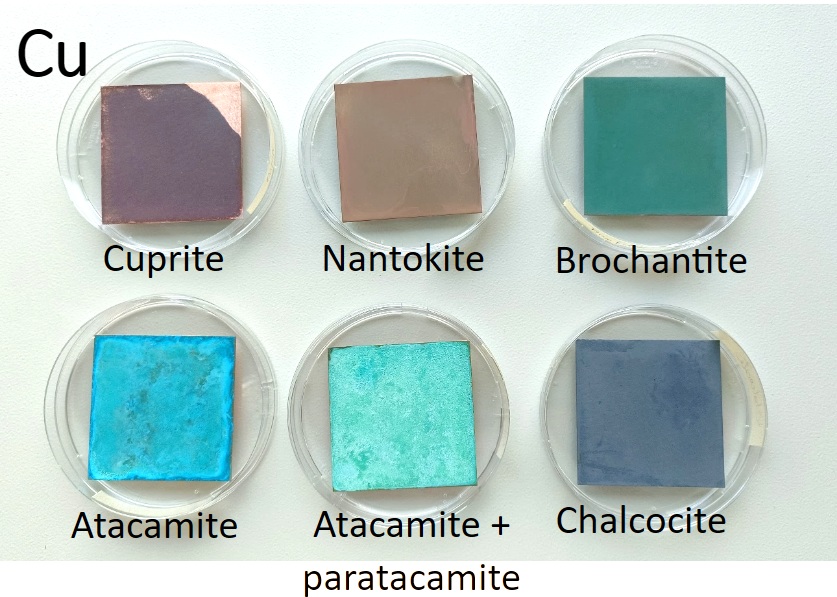
- Model samples were produced from copper-based coupons covered by each of the following corrosion products: cuprite, nantokite, trihydroxychlorides, brochantite, chalcocite which were fully documented (protocol of production, best suited imaging techniques and analyses among those available (optical microscopy, scanning electron microscopy, reflectance transformation imaging; energy dispersive, Raman, FTIR spectroscopies).
- Their electrochemical behaviour in 1% (w/v) sodium sesquicarbonate with Pleco® was investigated in order to establish the conditions for their local transformation/reduction using OCP measurements over time and LSV plots. Analytical examinations on the surface enabled the reactions provoked to be assessed.
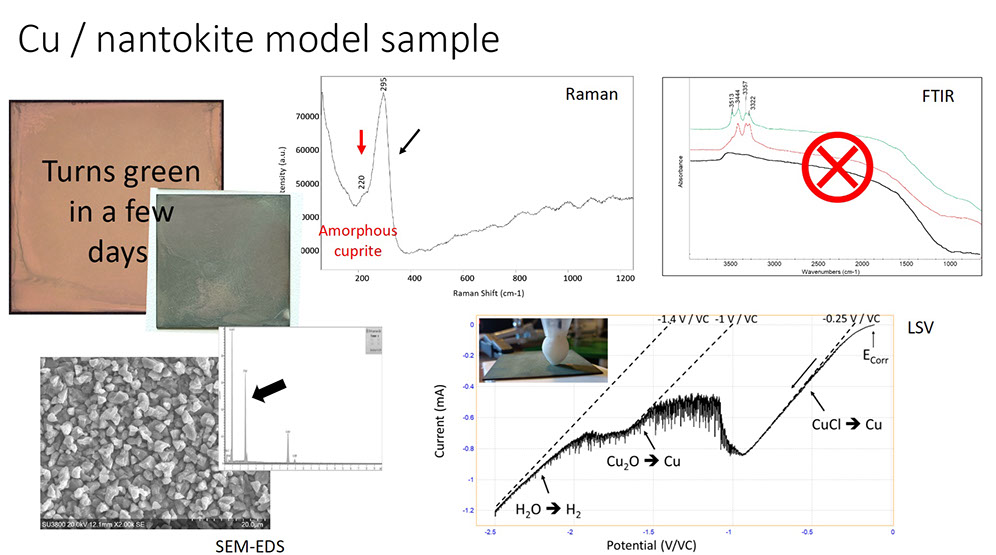
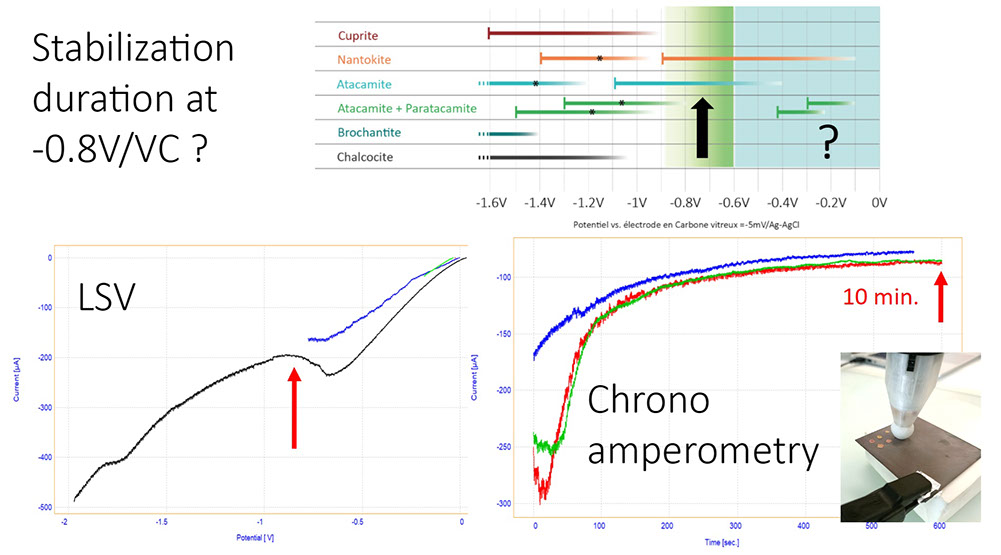
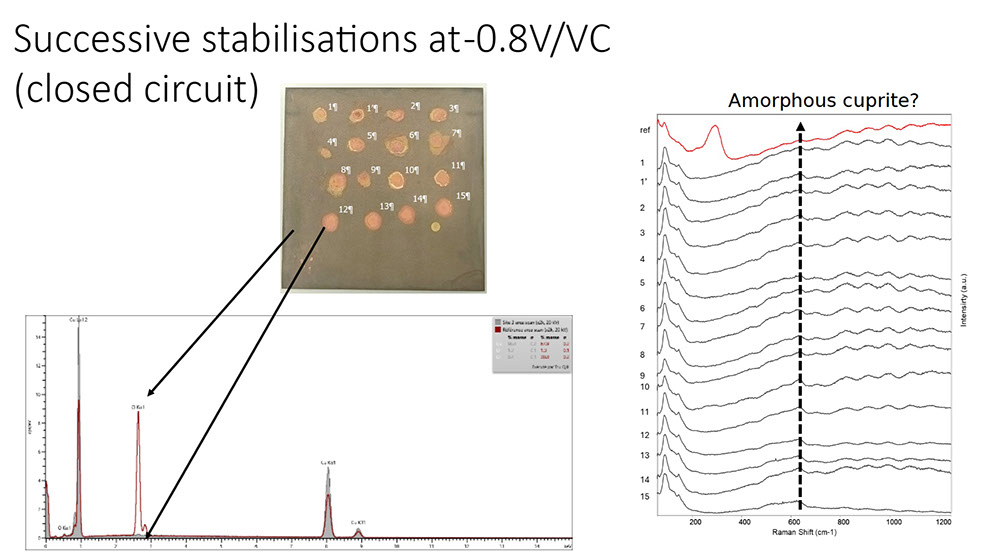
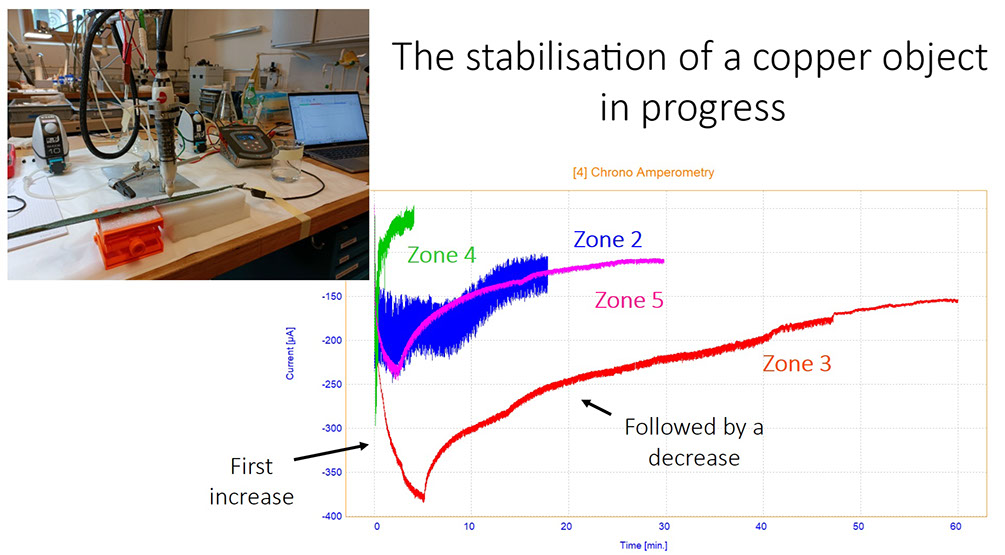
- Local stabilisation protocols using Pleco® were defined: nantokite is the first corrosion product to be reduced in sodium sesquicarbonate among those studied. The potential corresponding to the maximum of the reduction peak lies between -0.7 and -1V / VC, a range which ensures risk-free treatment regarding other corrosion products. Nantokite appears to be the only compound whose visual appearance changes radically upon polarisation at these cathodic potentials. It is accompanied by a change in microstructure. Chronoamperometry at -0.8V/VC are carried out to monitor the reduction process. The reduction current first increases more or less rapidly before decreasing slowly to reach finally a stable value. The closed-circuit operation can be repeated on multiple surface areas of the same object subject to active corrosion, without changing the electrolyte : the concentration of chlorides extracted is too little to contaminate other areas which are stabilised in the same way.
- Application of the parameters selected to active copper-based objects representative of museum collections. The localised stabilisation proceeded without significant issues. However, given the complex corrosion structure (atacamite/cuprite/nantokite), the treatment required thorough mechanical cleaning of the surface layers (atacamite) to gain access to the underlying nantokite layer. As residual corrosion layers are not always highly conductive, the reduction current tended to rise before decreasing continuously, indicating that reduction was underway. Conversely, this decrease occurred immediately when the corrosion layers were thin. A cathodic potential of -1 V/CV (≈Ag/AgCl) was required, with a maximum treatment duration of one hour per area. The same protocol (pre-mechanical cleaning of atacamite and/or any hard green corrosion products underneath in the case of bronze artefacts, followed by monitoring of ECorr over time and LSV measurements during short duration to check the conductivity of the metal surface and chronoamperometry at -1 V/VC during a few hours) was applied successfully on all other objects of the MCAH collection.
The thirteen newsletters for the Lesaccho project were distributed throughout the project's duration to individuals who had expressed an interest in staying informed about the project's results. They remain available to any professional wishing to receive them.
COST (European Cooperation in Science and Technology) is a funding agency for research and innovation networks. Our Actions help connect research initiatives across Europe and enable scientists to grow their ideas by sharing them with their peers. This boosts their research, career and innovation.
COST - Endless Metal © 2023 All Rights Reserved

Funded by
the European Union